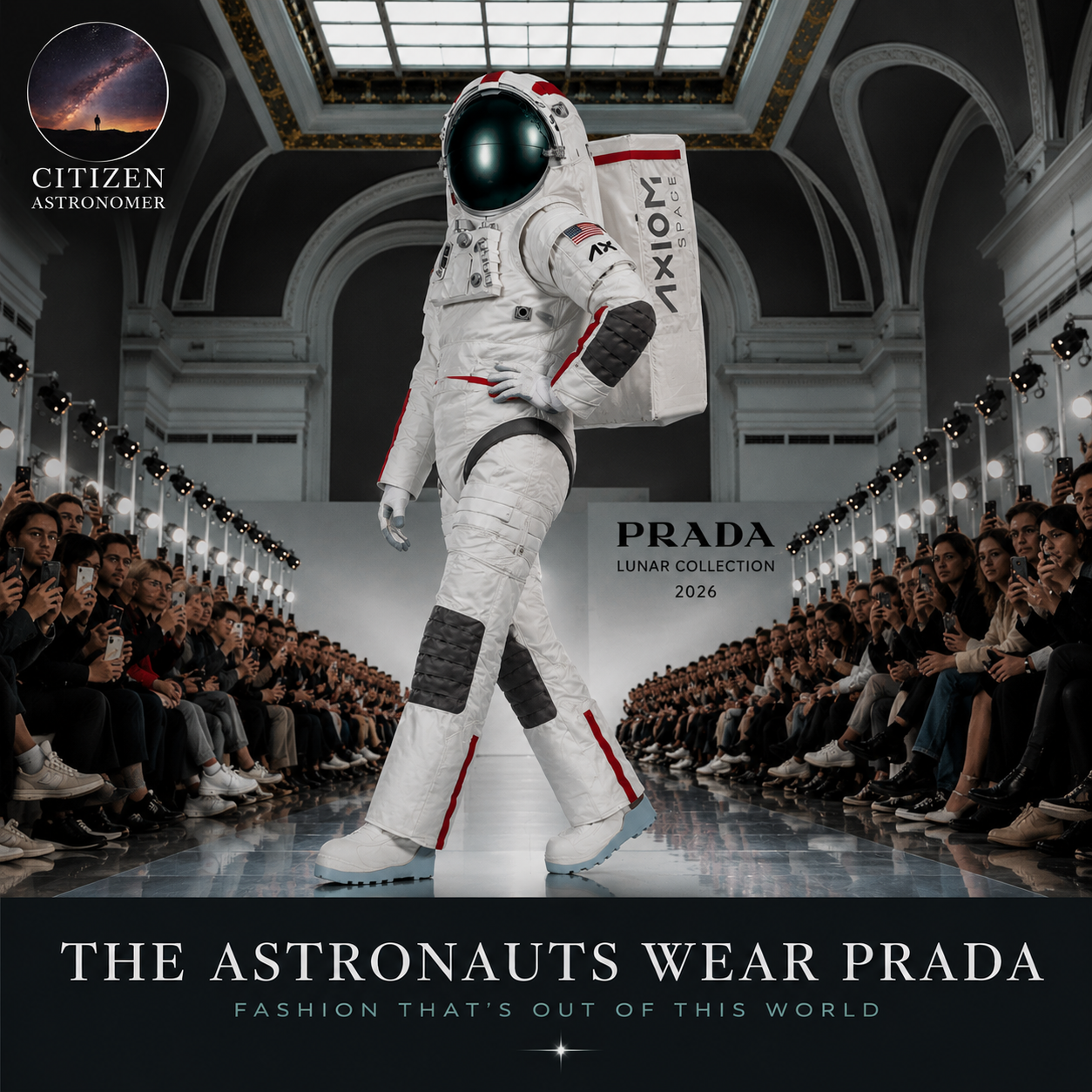
Does this spacesuit make my butt look big? What a Luxury Fashion House Can Teach Us About Building a Better Spacesuit
Estimated reading time: 7 minutes
What do NASA and one of the world’s most famous fashion houses have in common?
When headlines announced that Prada was helping develop a next-generation lunar spacesuit, the internet reacted exactly as you might expect: designer moon boots, luxury space fashion, and astronauts strutting across the lunar surface as if it were a runway in Milan.
It was funny. It also missed the real story.
Prada is not choosing what astronauts will wear for a photo opportunity. Its engineers and designers are working with Axiom Space on the Axiom Extravehicular Mobility Unit, or AxEMU—a new suit intended for NASA’s Artemis lunar exploration program.
The challenge is not to make the suit look good. It is to keep an astronaut alive, comfortable, and productive for hours inside a sealed spacecraft worn like clothing.
A Spacesuit Is a Personal Spacecraft
A lunar spacesuit must do nearly everything a spacecraft does, only in a much smaller package. It supplies oxygen, maintains pressure around the body, removes carbon dioxide and humidity, regulates temperature, supports communications, and shields the astronaut from sharp lunar dust, micrometeoroids, and extreme heat and cold.
At the same time, it has to bend.
That last requirement is harder than it sounds. A pressurized suit naturally wants to become stiff, much like an inflated balloon. Every step, reach, or turn asks the astronaut to work against that pressure. A suit that preserves life but exhausts its wearer too quickly is not an effective exploration tool.
The AxEMU is therefore built around mobility as well as survival. Its joints and lower torso are designed to let astronauts kneel, bend at the hips, rotate, and reach the ground more easily. That matters because Artemis crews will not merely plant a flag. They will need to collect samples, operate instruments, handle tools, and work like field geologists in demanding terrain near the lunar south pole.
From Apollo to Artemis
The Apollo suits were extraordinary machines. The A7L and later A7LB suits gave astronauts independent life support, thermal control, communications, and protection from the lunar environment. Without them, the Moon landings would have been impossible.
But Apollo’s suits were designed for a different mission profile. They were individually fitted, used on relatively short expeditions, and had limited lower-body flexibility. Apollo astronauts often adopted a bouncing “bunny hop” to cross the surface. Bending down to retrieve a rock could be so awkward that they relied on long-handled tools or carefully practiced ways of kneeling and standing again.
AxEMU carries Apollo’s basic idea forward while taking advantage of more than fifty years of materials research, computer modeling, human-factors testing, and life-support development.
Some of the most important enhancements include:
- Greater mobility. Improved joint design is intended to make walking, kneeling, bending, and geological work less tiring.
- A broader range of sizes. The architecture is designed to accommodate astronauts across a much wider range of body types—from the first to the 99th percentile—rather than treating a narrow body profile as the default.
- Longer excursions. AxEMU is being designed for moonwalks lasting at least eight hours. Apollo’s portable life-support system provided roughly six hours of primary operation, plus emergency reserve capability.
- More capable life support. A regenerable carbon-dioxide-removal system can be reused, unlike the consumable lithium-hydroxide canisters used during Apollo. Multiple redundant systems and onboard diagnostics give the crew more ways to detect and respond to trouble.
- Protection for the lunar south pole. The suit must tolerate severe thermal conditions, including time in permanently shadowed regions where temperatures can fall to about –250°F (–157°C). Specialized boots, outer materials, and coatings help manage that environment.
- Better visibility and gloves. Advanced helmet and visor coatings are intended to improve the astronaut’s view, while custom gloves aim to preserve dexterity for detailed work.
These are not cosmetic improvements. Better mobility means less fatigue and more science. A wider sizing range means more astronauts can use the suit safely. Redundancy and diagnostics mean a failure is less likely to become an emergency.
Did You Know?
Apollo astronauts discovered that lunar dust was more than a housekeeping nuisance. Its fine, sharp particles clung to suits, abraded outer fabrics, and worked their way into seals and mechanisms. Modern lunar-suit development treats dust resistance as an engineering requirement informed directly by those Apollo lessons.
The Technology Closest to the Astronaut
One of the AxEMU’s most important components is almost invisible from the outside: the Liquid Cooling and Ventilation Garment (LCVG).
An astronaut doing physical work inside an insulated pressure suit produces a great deal of metabolic heat. On Earth, sweat can evaporate into the surrounding air. Inside a spacesuit, that heat and moisture have nowhere useful to go.
The LCVG solves the problem by circulating cool water through a network of small tubes routed across major muscle groups. The water absorbs body heat and carries it to the suit’s portable life-support system, which rejects the heat to space. A separate ventilation loop directs fresh oxygen across the astronaut’s face, moves exhaled carbon dioxide away, and sends the gas through the suit’s scrubber before oxygen is recirculated.
Apollo astronauts wore liquid-cooling garments too, so the principle is not new. The improvement lies in how the idea has been refined. The AxEMU garment uses modern engineered knitting, specialized fibers, and advanced three-dimensional modeling to improve fit and comfort while preserving cooling and airflow. It is also designed for repeated use during longer missions.
Most significantly, its cooling system is fully redundant. If the primary cooling circuit fails, a second loop is available. In a place where overheating can quickly become dangerous and help may be far away, redundancy is not a luxury. It is survival engineering.
So Why Prada?
High-performance fashion and spacesuit engineering share more territory than the headlines suggest. Both depend on textile behavior, precise patternmaking, ergonomic construction, durability, flexibility, and an understanding of how a garment moves with the human body.
Prada brought experience in advanced materials, manufacturing, engineered knitting, and three-dimensional garment development. The collaboration began with the AxEMU’s outer layer, designed to help protect against the thermal and micrometeoroid environment of the lunar south pole, and later expanded to the inner cooling garment.
Axiom Space remains the spacesuit developer, building on technology and requirements developed with NASA. Prada contributes a different kind of engineering knowledge: how to turn complex materials into something a person can wear and work in for hours.
That distinction matters. This is not fashion replacing aerospace engineering. It is textile and garment expertise becoming part of aerospace engineering.
The Bigger Story
The real story is not that astronauts will wear a famous label on the Moon. It is that modern exploration increasingly depends on collaboration across disciplines.
The AxEMU links lessons from Apollo with new work in life support, materials science, biomechanics, digital modeling, and high-performance apparel. Its familiar white silhouette may resemble the suits worn more than half a century ago, but beneath the surface is a system designed for longer excursions, more varied astronauts, harsher terrain, and more ambitious science.
Citizen Astronomer Takeaway
It is easy to laugh at the headline that astronauts will wear Prada. What they will really wear is decades of experience—Apollo lessons, modern engineering, materials science, and human ingenuity—stitched together into a personal spacecraft. That is the story worth remembering.
Further Reading
- Axiom Space — AxEMU flight design and capabilities
- Prada Group — The AxEMU inner cooling garment
- NASA — Artemis spacesuits and mobility
- NASA — What Apollo suits taught engineers about lunar dust
Explore • Learn • Look Up.