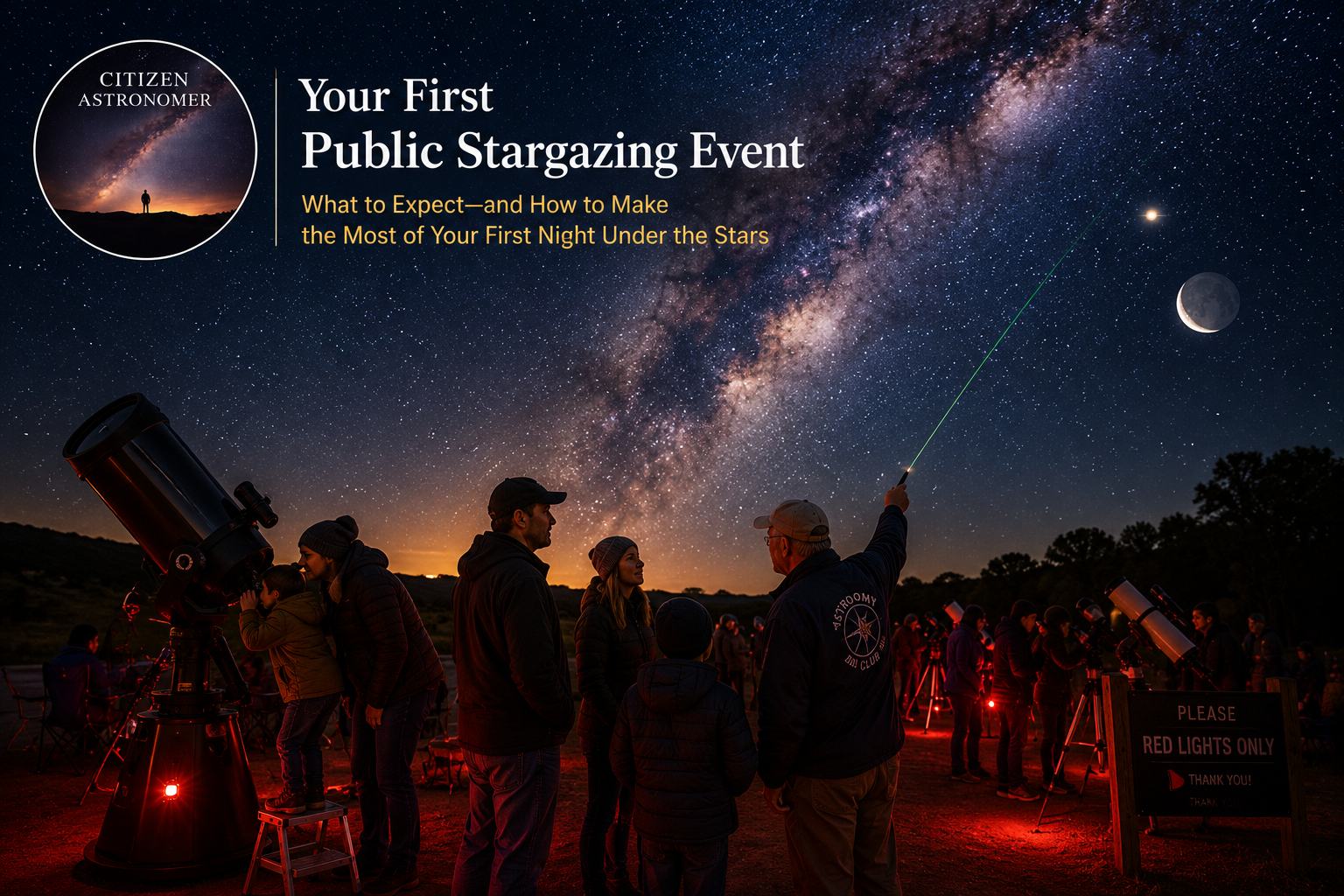
What to Expect—and How to Make the Most of Your First Night Under the Stars
Estimated reading time: 6 minutes

For many people, their very first look through a telescope becomes a lifelong memory.
Perhaps it’s the moment Saturn’s rings suddenly come into view, looking exactly like the pictures you’ve seen for years. Maybe it’s discovering that the Moon isn’t a smooth white disk at all, but a rugged landscape filled with towering mountains, enormous craters, and long shadows stretching across its surface. Or maybe it’s realizing that the faint fuzzy patch in the eyepiece is actually an entire galaxy containing hundreds of billions of stars.
Public astronomy observing events exist to create moments like these.
If you’ve never attended one before, though, the experience can feel a little intimidating. You’ll likely arrive at a dark park or observatory where people are assembling impressive-looking telescopes. Red flashlights glow in the darkness, conversations are filled with unfamiliar astronomical terms, and everyone else seems to know exactly what they’re doing.
The truth is much simpler: every one of those experienced astronomers was once attending their very first observing event too. Astronomy clubs love introducing newcomers to the night sky, and sharing the universe with others is one of the greatest joys of the hobby.
If you’re thinking about attending your first public observing event, here’s what you can expect—and how to make the most of the experience.
Why Public Observing Events Are Special
Unlike many hobbies that require expensive equipment before you can participate, astronomy is remarkably welcoming. Public observing nights allow anyone to experience high-quality telescopes completely free of charge. In a single evening, you might look through instruments ranging from a small beginner refractor to a large Dobsonian reflector capable of revealing astonishing celestial detail.
Just as importantly, you’ll meet the people behind the telescopes.
Astronomy clubs are filled with individuals who genuinely enjoy sharing their knowledge. Ask about a telescope, a camera, a constellation, or an object in the eyepiece, and you’ll likely receive an enthusiastic explanation. Amateur astronomers remember the excitement of their own first observing session and are usually delighted to help others experience it.
Public events also offer something the internet cannot: perspective. Looking at a photograph of Saturn is impressive, but seeing the planet with your own eyes—knowing the light entered your retina after traveling nearly 900 million miles—is an entirely different experience.
“Astronomy isn’t just about seeing distant objects. It’s about experiencing your place in a much larger universe.”
Arriving at the Event
If possible, arrive before darkness fully sets in. This gives you time to find parking, become familiar with the observing area, and meet some of the volunteers before everyone begins concentrating on the sky.
Many observing sites intentionally keep lighting to an absolute minimum. That’s why volunteers may ask arriving visitors to dim or turn off headlights once they’ve entered the observing area. Bright white light can temporarily ruin an astronomer’s night vision, requiring twenty to thirty minutes for full dark adaptation to return.
Don’t worry if you’re unfamiliar with the etiquette. Someone will gladly direct you where to park and answer any questions you have. Public events are designed with first-time visitors in mind.
If you’re bringing children, this is also a good opportunity to explain that telescopes are precision instruments. They aren’t fragile, but they do require careful handling. Most clubs are thrilled to help young astronomers look through a telescope—they simply ask that children wait for instructions before touching the equipment.
Meeting Your Fellow Astronomers
One of the biggest surprises for first-time visitors is just how approachable the astronomy community is.
The impressive telescope sitting in front of someone may represent years of saving, building, and learning—but don’t mistake that for exclusivity. Most telescope owners enjoy sharing their equipment far more than using it alone.
Feel free to introduce yourself. Mention that it’s your first observing event. That’s often all it takes to start a conversation that leads to views of planets, galaxies, nebulae, star clusters, double stars, and much more.
You’ll quickly discover that astronomy is as much about people as it is about telescopes. Experienced observers trade stories, compare equipment, discuss recent discoveries, and celebrate clear skies together. Before long, you’ll likely find yourself doing the same.
💡 Did You Know?
Many astronomy clubs have members who have spent decades observing the night sky. They can often locate hundreds of celestial objects without using computers or smartphone apps—a skill developed simply through years of practice beneath the stars.
Looking Through a Telescope for the First Time
For many visitors, this is the moment they’ve been waiting for.
Someone steps away from their telescope, smiles, and says, “Would you like to take a look?” Moments later, you’re peering into an eyepiece at a world you’ve only seen in photographs.
Take your time.
Unlike looking at a computer screen, using a telescope takes a few seconds for your eyes to adjust. Move your eye slowly toward the eyepiece until the image comes into view. If you wear glasses because you’re nearsighted or farsighted, you can often remove them and let the telescope’s focus compensate. If you have significant astigmatism, however, you may prefer to leave your glasses on.
Don’t hesitate to tell the telescope operator if the object seems blurry or difficult to see. A slight adjustment to the focus is completely normal and something astronomers do throughout the night as temperatures change.
Once you’ve had your look, step aside so others can enjoy the view—but don’t feel rushed. Public observing events are about sharing the experience, not hurrying everyone through a line.
One of the best parts of a public observing night is hearing the reactions. “Wow!” is by far the most common first response.
What Will You Actually See?
This is perhaps the biggest surprise for first-time observers.
If your expectations come from images captured by the Hubble Space Telescope or the James Webb Space Telescope, the view through an eyepiece may seem more subtle than you imagined. Those incredible photographs are created using long exposures, advanced cameras, and sophisticated image processing that reveal details invisible to the human eye.
Through a telescope, the experience is different—but no less extraordinary.
Planets often provide the biggest “wow” moments. Saturn’s rings are unmistakable. Jupiter’s cloud bands become visible, and on many nights you’ll also see its four largest moons lined up beside the planet. Mars occasionally reveals polar ice caps and dark surface markings when conditions are favorable.
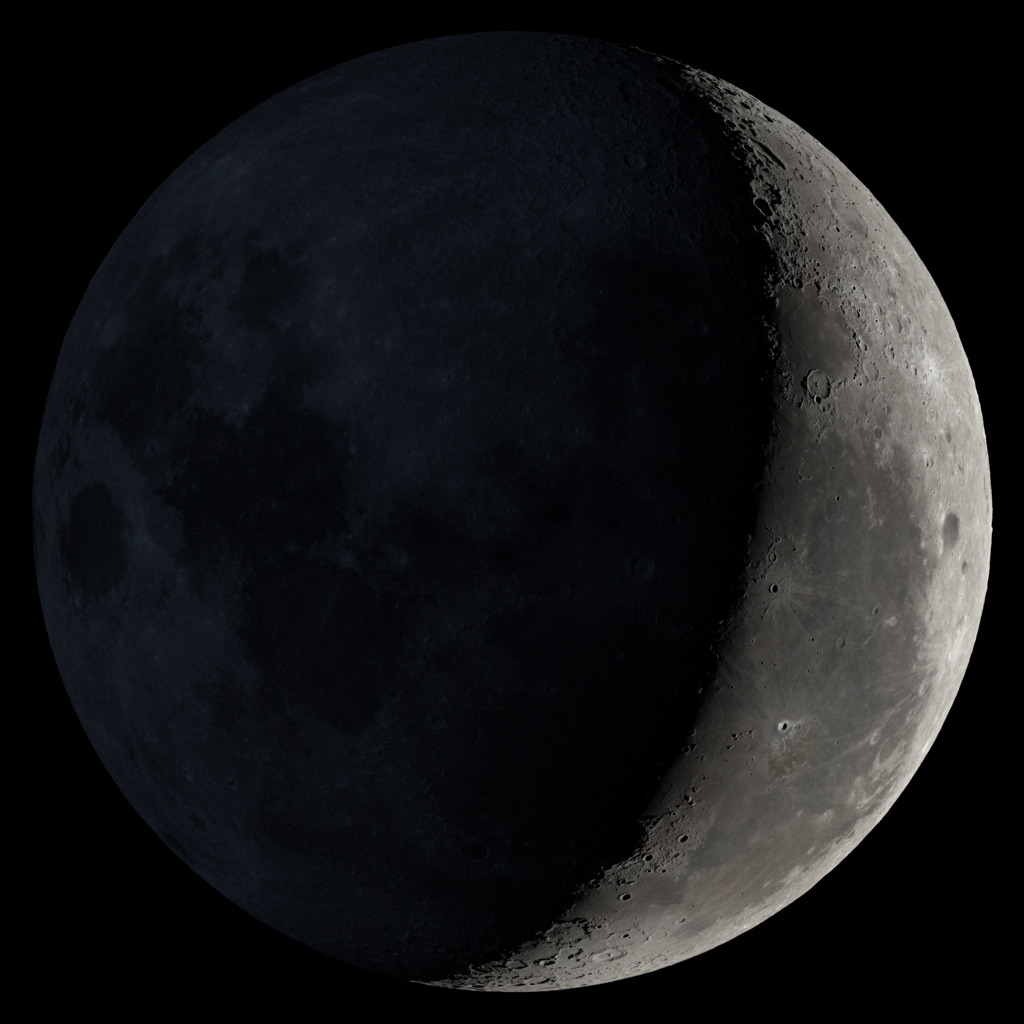
The Moon is another crowd favorite. At moderate magnification it transforms from a familiar bright disk into an incredibly detailed landscape filled with mountains, crater walls, lava plains, and dramatic shadows stretching across the lunar surface.
Galaxies and nebulae are more delicate. Instead of vibrant colors, you’ll often see soft gray shapes and faint clouds of light. That isn’t a limitation of the telescope—it’s a limitation of our own eyes in low-light conditions.
What makes these objects remarkable isn’t their color. It’s the realization that you’re seeing them directly with your own eyes. The light entering your retina may have traveled for millions—or even millions of years—before reaching Earth.
⭐ Citizen Astronomer Tip
Try looking slightly to the side of very faint objects instead of staring directly at them. This technique, called averted vision, uses the more light-sensitive parts of your retina and often makes galaxies and nebulae appear brighter.
Why Is Everyone Using Red Flashlights?
One of the first things you’ll notice is that nearly every flashlight at an observing event glows red instead of white.
This isn’t simply astronomy tradition—it’s biology.
Your eyes contain specialized cells called rods that become extremely sensitive in darkness. After about twenty to thirty minutes away from bright light, these cells allow you to detect incredibly faint objects in the night sky.
A quick blast of white light instantly resets much of that adaptation, making faint galaxies and nebulae disappear until your eyes recover.
Red light has much less impact on your dark adaptation, allowing you to read charts, adjust equipment, or walk safely without significantly reducing your ability to observe faint celestial objects.
Many astronomy clubs even place red film over flashlights or encourage visitors to switch their phones into red-screen “night mode” before arriving.
Simple Telescope Etiquette
Public observing events are relaxed and welcoming, but there are a few simple courtesies that help everyone enjoy the evening.
- Always ask before touching a telescope or camera.
- Allow the telescope operator to position and focus the instrument unless invited to help.
- Avoid leaning on the telescope while observing.
- Keep flash photography turned off.
- If using a smartphone, reduce its brightness before entering the observing area.
- Be mindful of conversations near people who are concentrating on observing or imaging.
- If you’re unsure about something, simply ask. Amateur astronomers enjoy explaining their equipment.
Remember that many of these telescopes are tracking objects moving across the sky at Earth’s rotation rate. Even a small bump can cause the object to drift out of view, requiring it to be located again.
Curiosity is always welcome. Nearly every telescope owner enjoys talking about their equipment as much as using it.
Don’t Be Afraid to Ask Questions
No one expects you to know the names of constellations or understand how telescopes work. In fact, public observing nights exist specifically to answer those questions.
Wondering why one telescope is so much larger than another? Curious how astronomers find objects in the sky? Interested in getting started with your own equipment? Ask away.
Most amateur astronomers are delighted to share what they’ve learned because someone once did the same for them. Every question helps make astronomy a little less mysterious—and a little more accessible.
Dress for the Sky, Not the Calendar
One of the most common comments heard at public observing events has nothing to do with astronomy.
“I wish I had brought another jacket.”
Standing outside under a clear night sky feels much colder than many people expect. Even during summer, temperatures often drop quickly after sunset, and because you’ll spend much of the evening standing still, your body won’t generate much heat.
A simple rule experienced observers live by is this: dress for weather about 10°F (5°C) colder than the forecast. Layers are your best friend. It’s much easier to remove a jacket than wish you had brought one.
Comfortable shoes, a hat on chilly evenings, insect repellent during mosquito season, and a folding lawn chair can make a surprising difference if you plan to spend several hours under the stars.
If you wear glasses, bring them. If you have binoculars, bring those too. Many visitors are surprised by how much they can see with a simple pair of binoculars before ever looking through a telescope.
Weather Is Part of Astronomy
Unlike many outdoor events, astronomy depends almost entirely on the sky cooperating.
A beautiful sunny afternoon can still turn into a disappointing observing night if clouds arrive after sunset. Likewise, a forecast that appears questionable in the morning may clear completely by evening.
Most astronomy clubs closely monitor weather forecasts and will announce postponements or cancellations on their website or social media if conditions aren’t suitable. Before leaving home, it’s always worth taking a quick look to make sure the event is still taking place.
If your first observing night is canceled, don’t be discouraged. Astronomers joke that cloud forecasting is one of the hobby’s unofficial specialties, and patience is simply part of spending time under the night sky.
Bringing Children
Public observing events are among the best family activities available. Many lifelong amateur astronomers trace their passion back to a single evening when someone invited them to look through a telescope as a child.
Children are naturally curious, and astronomy rewards curiosity. Encourage them to ask questions, compare what they see through different telescopes, and simply spend time looking up. The stars have a wonderful way of inspiring questions about science, history, exploration, and our place in the universe.
If you’re attending with young children, it’s helpful to remind them that telescopes are precision scientific instruments. Most astronomers genuinely enjoy sharing them—they simply appreciate a little care and supervision while everyone takes turns observing.
A Few Final Tips Before You Go
- ✔ Arrive before darkness if possible.
- ✔ Dress in layers—even during summer.
- ✔ Bring a red flashlight, or switch your phone to a red night mode if available.
- ✔ Turn off your camera flash.
- ✔ Feel free to ask questions.
- ✔ Be patient while waiting your turn at a telescope.
- ✔ Take a few moments to simply look up with your own eyes.
Sometimes the most memorable part of an observing night isn’t found through a telescope at all. It might be spotting a meteor streak across the sky, watching the Milky Way emerge overhead, or simply realizing how many stars become visible once your eyes adjust to the darkness.
💡 Did You Know?
Under exceptionally dark skies, the average person can see around 2,500 to 3,000 stars with the unaided eye. From most suburban neighborhoods, light pollution reduces that number to only a few hundred—and in the centers of large cities, sometimes fewer than fifty. One visit to a dark observing site can completely change the way you think about the night sky.
Citizen Astronomer Takeaway
Every experienced amateur astronomer remembers the first time they looked through a telescope. For many, it wasn’t the equipment that made the evening unforgettable—it was the person standing beside it, eager to share the view.
Public observing events aren’t just opportunities to see planets, galaxies, or nebulae. They’re opportunities to discover a welcoming community of people who enjoy exploring the universe together. Whether you’re eight years old or eighty, there’s something uniquely inspiring about seeing distant worlds with your own eyes and realizing just how vast—and beautiful—our universe really is.
If you’ve been thinking about attending a public observing event, consider this your invitation. Bring your curiosity, dress a little warmer than you think you need to, and don’t be afraid to ask questions. The universe has been waiting billions of years for you to see it.
The night sky belongs to everyone. All you have to do is step outside and look up.
Citizen Astronomer exists to make astronomy approachable, accurate, and inspiring for everyone—from first-time observers to lifelong stargazers.